

Abdominal Quadrants, Regions and Their Organs
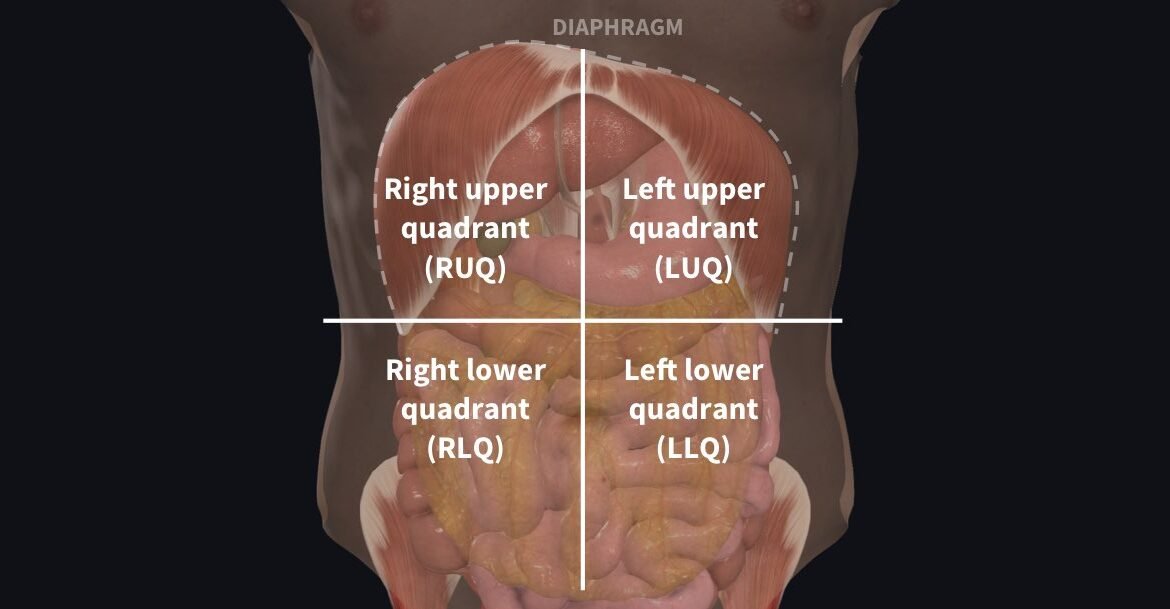
The abdomen has nine anatomical regions and four abdominal quadrants. During an abdominal exam, these classifications help clinicians make differential diagnoses and communicate.
Four Abdominal Quadrants
The abdomen has four quadrants: right upper, left upper, right lower, and left lower. These abdominal quadrants are often abbreviated RUQ, LUQ, RLQ, and LLQ. Remember two things about these four quadrants:
The navel (belly button) will help you visualize these quadrants during assessments. This is where the planes intersect. Left/right and “upper/lower” always refer to anatomical positions, not yours. Most students confuse right and left regions, so be careful!
Four Quadrant Major Organs
Each of the four abdominal quadrants has these major organs:
- Right Upper Quadrant: Liver, stomach, gallbladder, duodenum, right kidney, pancreas, adrenal gland.
- Left Upper Quadrant: Liver, stomach, pancreas, kidney, spleen, and adrenal gland.
- Right lower quadrant: appendix, reproductive organs, ureter.
- Left lower quadrant: ureter, reproductive organs
NOTE: Small and large intestines are in all quadrants.
Nine Abdominal Regions
According to pain physicians in Dallas, nine abdominal regions use two parasagittal planes (midclavicular planes) and two horizontal (transverse) planes to divide the abdomen into smaller sections. The superior transverse plane, the subcostal plane, is below the ribs. The intertubercular plane, inferior transverse plane, intersects pelvic tubercles just below the navel. First, let’s discuss the right and left columns, which are named after their nearest bones and have the same name (with a left or right prefix). When studying anatomy, learn common prefixes and suffixes—they will help you repeatedly! Left and Right Hypochondriac Regions: “hypo” means below or under. The word “chondriac” means rib cartilage. When assembled, this is the abdominal region under the ribs.
Left and Right Lumbar Regions: The lower back vertebrae nearest the lumbar region are called lumbar. From there, this region is named.
Located on the top of the hip bone is the iliac crest, which is closest to the iliac region. That covers the left and right columns. The middle column contains abdominal regions. Unlike the left and right side columns, these regions are named after their stomach location, not bones.
Epigastric Region: “Epi” means above or over, and “gastric” means stomach or belly. This is the area above the belly.
This is easy to remember because the umbilical region contains your navel or umbilicus. The navel marks the four-quadrant intersection and reminds you that the umbilical region is in the middle of the nine abdominal regions. The Hypogastric Region We know hypo means “below,” and gastric means stomach or belly. Thus, the hypogastric region is below the belly. For side columns, the names are Hypochondriac, Lumbar, and Iliac (HLI). This can help you remember these regions. Epigastric, Umbilical, and Hypogastric comprise the middle column.
Nine-Abdominal Organs
Let’s examine each region’s major organs. Most basic anatomy professors don’t expect you to memorize a list of organs in each region, but they want you to understand their locations.
- Right Hypochondriac Region: Liver, gallbladder, right kidney, and small and large intestines.
- Epigastric Region: The liver, stomach, pancreas, duodenum, spleen, and adrenal glands are here.
- Left Hypochondriac Region: The spleen, large/small intestines, left kidney, pancreas, stomach, and liver tip are in the left hypochondriac region.
- Right Lumbar Region: In the right lumbar region are the ascending colon, small intestine, and right kidney.
- Umbilical Region: In the umbilical region are the duodenum, small intestine, and transverse colon.
- Left Lumbar: The descending colon, small intestine, and left kidney are here.
- Right Ilium: The right ileum contains the appendix, cecum, ascending colon, and small intestine.
- Hypogastric Region: The bladder, sigmoid colon, small intestine, and reproductive organs are in the hypogastric region.
- Left Iliac Region: The sigmoid colon, descending colon, and small intestine are here.
Possible Causes of Pain by Abdominal Quadrants
Causes in RUQ
The Right Upper Quadrant (RUQ) of the abdomen contains vital organs like the liver, gallbladder, right kidney, and a portion of the small intestine. Pain or discomfort in this area may be caused by gallstones, which block the bile ducts and lead to sharp pain after meals. Liver conditions such as hepatitis or fatty liver disease are also common in the RUQ and may present with dull or persistent pain. Infections in the right kidney or inflammation in the bile ducts can also be responsible for RUQ discomfort. In some cases, lower lobe pneumonia of the right lung can cause referred pain to this area.
Causes in LUQ
The Left Upper Quadrant (LUQ) houses the stomach, spleen, pancreas, and part of the colon. Pain in the LUQ is often associated with gastric problems such as gastritis, acid reflux, or stomach ulcers. These conditions may develop due to infections, excessive use of NSAIDs, or poor dietary habits. Pancreatitis, which is inflammation of the pancreas, can also cause severe pain in this region. Additionally, an enlarged spleen due to infections or blood disorders might lead to discomfort or tenderness in the LUQ. Sometimes, trauma or injury to the ribs can also radiate pain into this quadrant.
Causes in RLQ
The Right Lower Quadrant (RLQ) is most commonly known for being the site of appendix-related pain. Appendicitis is a major concern and requires immediate medical attention. Apart from that, kidney stones moving through the urinary tract can cause sharp, stabbing pain in this area. In women, ovarian cysts or ectopic pregnancy may be responsible for pain in the RLQ. Conditions like inflammatory bowel disease (Crohn’s disease or ulcerative colitis) can also affect the lower intestines and lead to cramping or chronic discomfort in this quadrant.
Causes in LLQ
The Left Lower Quadrant (LLQ) mainly involves the descending and sigmoid colon, as well as reproductive organs in females. A common cause of pain in this quadrant is diverticulitis, which is the inflammation of small pouches in the colon wall. This condition is often linked to a low-fiber diet and aging. Women may also experience LLQ pain due to endometriosis or ovarian issues. Irritable Bowel Syndrome (IBS), which causes alternating diarrhea and constipation, is another common culprit. In some cases, hernias or minor intestinal blockages may also present with discomfort in this region.
Clinical Significance
If LLQ one of the abdominal quadrants abdominal pain or peritonitis is present, colitis, diverticulitis, ureteral colic, ovarian cysts, or pelvic inflammatory disease may be suspected. Colon and ovarian tumours are left lower quadrant tumours. Intestinal malrotation can cause LUQ pain. In hepatitis, cholecystitis, and peptic ulcer, the RUQ may hurt. Incase of severe pain, contact pain management in plano. Appendicitis can cause pain and tenderness in the RLQ, especially the right inguinal region or right iliac fossa.